
Adventures by The Resurrected GM
resurrectedgm.com

The Pantheon of Cindarath


Elyndra, Flame of Desire: Goddess of Beauty, Love, Fertility, & Passion
Elyndra was born from the Many-Faced God as an expression of what that deity could never be: raw, radiant desire incarnate. Where the Many-Faced God embodies change and masks, Elyndra is the mask willingly worn—the form one wants to see, wants to be seen. She is passion made flesh, and longing given purpose.
She is the goddess of love in all forms: romantic, lustful, familial, and even self-love—but she also governs the pain of desire unmet, the jealousies that twist hearts, and the dangerous fires of obsession. Her worshippers say she walks between joy and ruin for no heart burns without risking the burn of another. Unlike her father, who dwells in shifting truths, Elyndra delights in clarity of feeling—even if it leads to madness or destruction.
The Many Faced God: Deceiver, Creator, Fate-Shaper
The Many-Faced God is an enigma wrapped in divine mischief, worshiped under countless names and forms across the world. His true nature is elusive—one moment the benevolent architect of life, the next, a cunning trickster weaving chaos into the mortal realm. His followers know that to worship him is to embrace uncertainty, for his favor is as fleeting as the wind, and his blessings often come at an unforeseen price.


Orvandir, The Verdant Father: God of Nature, and the Seasons
Born from the breath of the world itself, he took form as an ancient being woven from root and vine, crowned in leaves, with the eyes of the endless forest. Some say he is the heart of the dead Elder Titan Leturgis from whose corpse the World was made. Orvandir, neither wholly divine nor mortal, but the spirit of nature given will.
Orvandir is both the wild storm and the gentle breeze, the untamed predator and the nurturing earth. He does not seek dominion over nature, for he is nature—its guardian, its voice, and its wrath when the balance is broken.
Thalassara: Goddess of the Oceans and Deep Tides
Sister to Orvandir, Thalassara was born in the heart of the ocean. She is the embodiment of the ocean’s vastness and power, revered both as a bringer of life and a harbinger of destruction. Her spirit resides in the deepest trenches, yet her influence stretches across all waters—from the tranquil shores to the storm-tossed seas.

04

Praetus: God of Death
The brother of the Many-Faced God, Praetus is very much his brother’s opposite. Stoic and even-handed, Praetus’ is serene and patient in his function of leading humanity to its final destination. Many believe that Praetus is angry with his brother and that he was tricked into his position. This is a myth and far from the truth. Praetus chose his kingdom, recognizing that good judgement was required for one in his role.
Solvaris, The Eternal Radiance: God of the Sun, Prophecy & Healing
Solvaris was the first offspring of the Many-Faced God, crafted by him on the Celestial Forge. He is the eternal flame that banishes the shadows, the divine archer who casts his golden arrows to drive away darkness, and the healer whose touch restores the weary and wounded.
Legends tell of how Solvaris once waged war with his bow Aurflare to forge the cycle of day and night. This was not achieved without cost as, during the battle, Solvaris's left eye was ripped from his head. This eye, born of light and darkness, would grow to become Selmara, Goddess of the Moon and Magic.

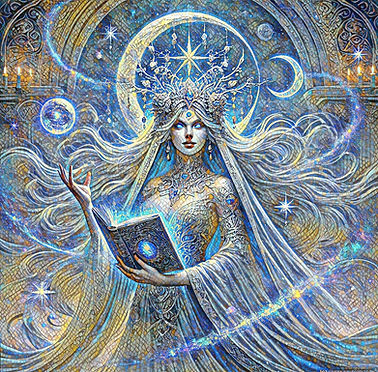
Selmara, The Silver Veil: Goddess of the Moon, Magic, & Dreams
The Eye of Solvaris was rescued by The Many-Faced God. He molded the eye with his hands and blew on it to cool it. With the touch of Creation and the Breath of Life, Selmara was born—the Moon Goddess, the Weaver of Mysteries and the Queen of the Dreamlands.
As she rose in the heavens, she brought light to the night sky. She spoke the first words of magic into the wind, crafting the hidden language of spells and the weave that flows through all things. While Solvaris governs the seen and the certain, Selmara rules the unseen, the unknown, and the whispered truths that lie between dreams and reality.
Valthor, The Ember-Forged: God of the Forge, Strength, & Craftmanship
Valthor was not born of the heavens like the other gods, nor did he rise from the primordial chaos. Instead, he was forged—a being of molten fury and unyielding strength, shaped in the heart of the world’s first volcano. It is said that when Solvaris loosed his golden arrows, one of the arrows struck deep into the earth and became the seed of fire from which Valthor emerged. With hands of iron and a heart of flame, he is revered for shaping both the first weapons of the gods, and the first plowshare to till the earth. He is the master of creation through fire and willpower; the divine smith whose hammer strikes shake the mountains and makes the lightning flash and the thunder rumble. Where others see raw metal, he sees potential. Where others see failure, he sees the chance to reforge something stronger.


Veyra: Goddess of Battle, Strategy, Honor and Victory
During the battles with the Titans, the divine smith Valthor forged a spear so perfect, so sharp, that it could cut through the very chaos of war itself. He cast it into the heavens, where it struck the storm-ridden clouds and from the clash of steel and thunder, Veyra was born.
She emerged clad in silver and crimson, with eyes like storm-lit steel and hair of flame. She was not merely a goddess of battle, but of mastery over battle—not brute slaughter, but the calculated, honed skill of the warrior, the strategy of the commander, and the unbreakable bond of those who fight side by side. It is she who whispers tactics to generals in their sleep, and who weighs the fate of warriors before their final stand.
Eryndor: God of Knowledge, Writing and Justice
Legends say that at one time, Praetus grew lonely in his Land of the Dead and sought solace from his godly brethen. All feared Praetus as they knew that even Gods may die. All, that is, except Veyra. The goddess of war loved and respected Praetus (which is why war and death are eternally linked) and in the end, bore him a son. And this son was Eryndor.
It was he who first gave form to language, who carved the runes of wisdom into the bones of the world, ensuring that no truth—no lesson hard-learned—would ever be lost to time. Though revered as a god of learning, he is no passive scholar. He is also the keeper of justice, the divine arbiter of truth. Kings, scribes, and judges invoke his name when seeking fairness, for he sees not with eyes, but with the ink of fate itself.


Theron: God of Healing, Medicine & Compassion
In the first age of the world, when mortals knew only pain and death, wounds festered, plagues ran rampant, and even the gods turned their faces away from the suffering of the weak. It was then that Theron arose—not from the fire of war nor the forge of creation, but from the first act of mercy. Born on a godly battlefield, where Theron touched, flesh mended, breath returned, and pain faded. From that moment, he was known as Theron, The Hand of Mercy, the divine god of healing.
Unlike many gods, Theron does not dwell in celestial halls or demand grand temples. Instead, he walks unseen among the suffering, guiding the hands of healers, whispering remedies to those who seek them, and easing the pain of the dying so that they may pass in peace. He does not grant immortality nor undo death’s natural course, but he mends what is broken until its time has truly come.
Vaelion, The Golden Wayfarer: God of Art, Travel, & Luck
Vaelion is the ever-wandering god, the patron of those who create, trade, and journey. He is said to have been born at the crossroads of the world, where the first merchant struck a deal, where the first bard sang a song, and where the first traveler set forth into the unknown. Unlike many gods, he does not sit upon a lofty throne but walks among mortals, laughing in their taverns, bartering in their markets, and inspiring their greatest works.


Zhaeryn, the Sanguine Maw: God of Destruction & Gluttony
In the final battle against the Elder Titan Leturgis, one of the Many-Faced God many masks was ripped from its divine face. The mask—wrenched from its god-flesh and bleeding power-- crawled like a wounded beast until it reached the titan’s cursed corpse and consumed a fragment of Leturgis's corrupted flesh. There, in the blood-soaked ruin of gods and monsters, something new was born.
The mask, once divine, now twisted with infernal, primordial, and celestial decay, gave rise to a hunger that the planes had never known. From the face of a god came another god—twisted by hunger, greed and suffering.
It’s name is Zhaeryn. It is the embodiment of want—an insatiable hunger for power, for wealth, for dominion. A craving that devours kings, topples empires, and leaves only ash in its wake. Zhaeryn is infernal gluttony made divine.